

.png)
The average Canadian financial advisor is managing over 100 households. To be responsive and build personal relationships with this number of clients is a huge undertaking. All the while every single interaction needs to be auditable, archived and secure.
Every advisor is managing the complicated balance between security, regulatory and compliance pressures alongside an ever growing client expectation for convenience.
So habit is pushing advisors towards email, regulatory bodies are pushing advisors towards client portals and clients and convenience are pushing advisors towards WhatsApp and SMS.
In a recent interview our CEO, Laurent Guyot, takes an in depth look at the challenges of legacy tools like email and SMS, the increasing adoption of unapproved messaging apps like WhatsApp, and how the industry must evolve to protect both client relationships and data security.
"It's regulatory, security and client expectations — and finding the time to manage all of that during a busy day," says Laurent Guyot, CEO of Qwil Messenger.
The pressures advisors are facing: Regulation & Security Vs Client Expectations
Clients increasingly expect instant, frictionless communication. Similar to the seamless messaging experience they experience in their social lives, from a WhatsApp or a Facebook Messenger.
However, for an advisor, managing over 100 clients, conducting personalised, responsive communication through traditional communication models is close to impossible. Not to mention the problems raised by those legacy communication channels:
The security threat of email
Many advisors still rely on email as their primary communication channel despite the known vulnerabilities. Email in 2026 is still highly susceptible to cyber attacks. With approximately 92% of all cyberattacks originating through email.
Some firms implement an encrypted email or password protected encrypted portals to attempt a work-around. However this introduces friction on both sides. Whether that be a client being unable to log-in, then taking up support resources to regain access, to the unsolved issue of documents that need to be sent from the client to the advisor.
The result of this high friction is a lack of adoption, and in time, a relapse into legacy channels that feel convenient but don’t meet regulatory requirements.
The compliance failures of SMS
Canadian regulatory bodies, such as PIPEDA, CASL and CIRO require that all client communications are permanently archived, uneditable, and fully auditable as well as having explicit client consent. SMS technology fails on all fronts with its built in technology.
You then also face the problem of, where you have SMS communications, you run the risk of staff using personal devices to communicate with clients. The advisory business then faces severe operational risk if a staff member leaves and takes those client interactions with them.
SMS also has inherent functionality gaps for financial advisors. Within an SMS chain you can not host multi-party communication, say you wanted to “CC” someone from your admin team. You also lack the ability to securely share large documents, and are totally reliant on your carrier for delivery, with no knowledge of receipt.
Why the financial industry struggles to move beyond Legacy Communication Channels
So if most advisors know about the potential risks of using SMS and email, why do they still do it?
The “accident” paradox
"I usually compare it to accidents - you appreciate the risk, but you don't think it will happen to you. It's been fine so far, so why change?" Guyot explains.
Many professionals view cyberthreats as similar to car accidents. They acknowledge the risk but operate under the assumption that it would never happen to them. Because the channels they are so used to have “worked so far” there is a natural resistance to changing historically successful workflows.
Early compliance/technology solutions to these challenges often made communication harder. Leaving many early adopters to believe that new security and communication tools always equals more friction. With ever growing pressure from clients to provide easier communication, not harder, advisors remain on the channels they are comfortable with.
In addition to client pressure, implementing new tools and workflows traditionally would take significant time and training. Again presenting the advisors with the choice of convenience vs compliance.
Larger advisor networks, who typically had rigid technology stacks, the decision to undertake new tools was an even greater one. With most finding it easier to deny new tools rather than approve, despite the operational and security challenges inflicted by emails and encrypted portals.
The influence of social messaging apps in financial advice
Our preferred method of communication in our social lives is instant messaging. It is simple, asynchronous and the lowest time commitment to conduct conversations. Within the financial industry, the need for ease and efficiency has resulted in a shift towards using these platforms like WhatsApp and Facebook messenger in a professional capacity.
If we take a look at the usage of these platforms in Canada, we see why client expectations continue to shift toward instant, responsive and personal communication:
Advisors are increasingly tempted to use these channels for client communication due to the sheer number of users and convenience. Often we hear the caveat that “we don’t share sensitive communication over WhatsApp.” However these consumer tools present significant enterprise risks:
- Lack of control and monitoring: Firms cannot oversee or track conversations taking place on social, personal platforms.
- Identity verification blindspots: Unlike corporate purposed tools, social platforms do not enforce identity verification. Making it easy to spoof, impersonate or phish for sensitive information. The encryption within a platform is irrelevant if we do not know who is on the other side.
- The Relapse Risk: Firms that outright ban these platforms, without offering a viable alternative to WhatsApp, rarely succeed. With advisors defaulting back to these channels for convenience, or facing the risk of falling behind other firms that meet the baseline expectations of clients for messaging-based communication.
"Banning these tools simply doesn't work, the key is offering an alternative built for the industry - not telling people to stop using something that already works for them." - Laurent Guyot
Navigating Canadian Regulations: PIPEDA and CASL
Financial advisors are relationship managers. Not cybersecurity experts. Yet the responsibility still falls on them to comply with and enforce the regulations set by bodies like PIPEDA and CASL.
For Canadian firms, data sovereignty and consumer protection laws determine the handling of client data. The two primary regulations are PIPEDA and CASL. A simple way to distinguish between the two is that CASL controls the permission to communicate, and PIPEDA regulates how you handle the data behind the communication.
What is CASL (Canada’s Anti-Spam Legislation)?
CASL applies to all “Commercial Electronic Messages (CEMs). This includes email, SMS and all instant messaging with commercial intent. CASL mandates 3 strict pillars:
- Expressed or implied consent
- Clear business identification
- Immediate, functional unsubscribe mechanisms
Non-compliance carries severe corporate penalties of up to $10 million per violation
What Is PIPEDA and Data Sovereignty?
The Personal Information Protection and Electronic Documents Act (PIPEDA), requires strict data safeguards and audit trails. For financial advisors the most relevant areas covered by PIPEDA are:
- Client consent to use and collect data
- Immediate data breach reporting to the office of the privacy commissioner
- Clients have the right to access their communication records (must be within 30 days)
- Physical, and technological safeguards and data security.
PIPEDA also covers data residency. Canadian advisors transferring data across borders, must prove that the host country meets the same security standards. This becomes relevant especially when considering communication platforms and client portals, and is a big reason why local hosting is essential.
Designing a Compliant, Modern Communication Experience
The answer for modern communication platforms for financial advisors is a channel that has the “whatsapp-style" interface that customers expect, with “banking-grade” security and compliance features regulations require.
A platform that truly meets the needs of Canadian financial advisors should focus on the following design standards:
- Security by design: Security and compliance should not be an add on. It should be the foundation of the platform. No third party archiving or manual encryptions. Just secure by design.
- Verified, branded environments: All communication and platform access should be within an invitation-only workspace. All users should be verified with 2 factor authentication to satisfy both PIPEDA’s safeguards and guarantee CASL’s need for explicit consent. This completely negates the threat of impersonation and phishing.
- Automated audit trails: Maintaining audit trails should not be an additional action. It should be by default and without the need of clunky third-party scrapers or manual tasks. The platform should automatically record an un-edible, searchable audit trail that can easily be extracted to provide the client with their communication records should they request them.
- Local data hosting: To simplify the data hosting and comply with PIPEDA by default, the ideal platform should utilise local data hosting in Canada. If the data never leaves Canada, there is a significant burden taken off the advisors.
- Unified toolsets & Integrations: Advisors should be able to host all their client communications within one place, that automatically syncs to their CRM. Having the ability to chat, video call, send documents, request signatures all in one workspace eliminates platform fatigue, on both advisor and client side. The ideal platform streamlines workflows, rather than simply adding another channel.
In essence, the overall goal of modern financial communication technology is to reduce compliance burden from the advisor’s workflow. Allowing advisors to focus on the services provided and client relationships, without exposing the firm to regulatory or cybersecurity risks.
"That's exactly why we built Qwil - not as another tool to learn, but as something that already feels familiar, so advisors and their clients can focus on the relationship, not the platform." - Laurent Guyot, Qwil Messenger CEO
How Qwil Solves these issues for Canadian Financial Advisors
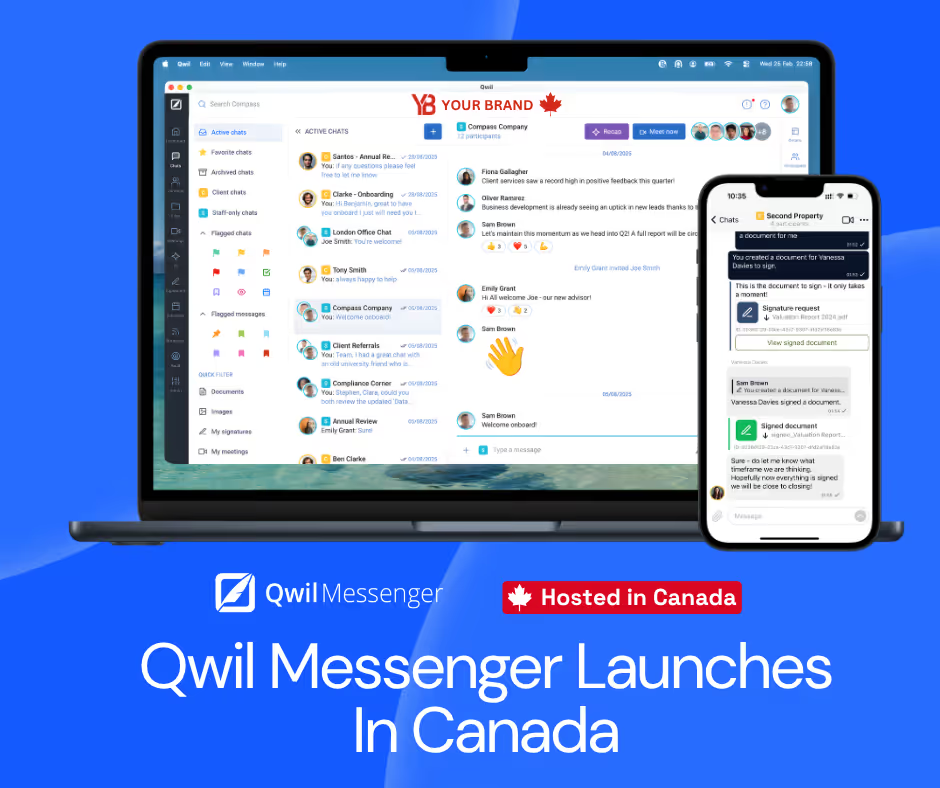
Qwil Messenger was built around exactly these standards. Every client is invited into a verified, branded workspace with 2FA - so there's never any doubt about who's on the other end. Every message, document and signature is automatically logged into a searchable, un-editable audit trail, ready if a client requests their records. Data stays hosted in Canada, removing the data sovereignty question entirely. And chat, video calls, e-signatures and document sharing all live in one place, syncing directly with CRMs like Wealthbox, Salesforce, HubSpot and Zoho.
The result: an interface as simple as WhatsApp, with the compliance built in from the start.
Switching tools can feel like a challenge. New habits and new tools, however the biggest risk is maintaining outdated systems until an accident occurs. We built Qwil Messenger to make the shift as easy as possible. No complicated outdated systems. Just verified, branded and compliant client communication, as easy as using WhatsApp.


Similar posts
.avif)
Start your 30-day free trial


.svg)