

.avif)
This guide is written for Canadian business owners, compliance leads, and operations managers who need to understand what secure messaging actually requires in 2026 - and how to choose, implement, and maintain a compliant communication platform that protects client data, satisfies Canadian privacy law, and keeps pace with regulators who are paying increasingly close attention to how businesses communicate electronically.
Overview: Secure Communications Needs for Canadian Businesses
Every Canadian business that communicates with clients, customers, or partners electronically is operating under a regulatory framework that most have never fully mapped. PIPEDA sets the ground rules for how private-sector organisations collect, use, and disclose personal information in the course of for-profit, commercial activities across Canada. That includes the messages you send, the documents you share, the signatures you collect, and the communication history you retain.
The regulatory pressure is real and intensifying. According to IBM, the average cost of a data breach reached about $4.88 million US in 2024. Canada's Digital Charter Implementation Act, when it comes fully into force, will raise penalties for serious privacy violations to 5% of global revenue - aligning Canada's enforcement posture more closely with GDPR's. The OPC is already more active: it launched an updated online breach-reporting form in 2025 and a new tool to help businesses assess the real risk of significant harm from privacy incidents.
For client-facing firms - financial advisors, healthcare providers, legal practices, accountants, real estate professionals - the communication channel is not just a compliance obligation. It is the primary relationship infrastructure. Clients who experience friction, insecurity, or unprofessionalism in how their firm communicates with them do not give feedback. They leave.
The starting point for secure communications in any Canadian business is digital sovereignty - the principle that your clients' data should be under your control, stored on Canadian soil, and subject to Canadian law.
Why Digital Sovereignty Matters for Canadian Businesses
Digital sovereignty is the ability of a business, institution, or country to control its own data, systems, and digital infrastructure. For Canadian businesses, it has a specific practical meaning: where is your client data stored, under whose laws, and who can access it without your knowledge?
Most Canadian businesses using US-based communication platforms - WhatsApp, standard SMS, Microsoft Teams in default configuration, Gmail - are storing client personal information on infrastructure subject to US federal law, including the CLOUD Act, which allows US law enforcement to compel access to data held by US technology companies regardless of where the data is physically stored. Many tools used in daily practice may store data outside of Canada or lack the necessary controls to meet Canadian compliance requirements.
The comparison is straightforward. Data hosted in Canada is subject to PIPEDA and provincial equivalents. Data hosted in the US on US infrastructure is additionally subject to US federal surveillance law - and your clients, who have trusted you with their personal financial, health, or legal information, have no practical way to know this is happening.
For regulated industries - financial services, healthcare, legal, accounting - the data residency question is also a regulatory question. PIPEDA's accountability principle requires that personal information transferred to a third party for processing is given comparable protection. If you cannot document where your communication data is stored and what legal protections apply to it, you cannot demonstrate that comparable protection exists.
The recommended data hosting policy for Canadian businesses serving Canadian clients is simple: require Canadian data residency from every communication and document platform in your stack. Document the confirmation in writing. Review it annually.
Choosing Secure Messaging and Instant Messaging Platforms
Must-Have Features for Canadian Businesses
When evaluating a secure instant messaging platform for business use, the minimum feature set for Canadian compliance should include:
True end-to-end encryption - not transport encryption (TLS) that decrypts at the server, but device-level E2EE where only the sender and recipient can read the content. The distinction matters enormously: a TLS-only platform means the vendor can access your messages, and a server breach exposes every conversation ever stored there.
Canadian data hosting - confirmation in writing that messages, documents, and audit records are stored within Canadian infrastructure and do not transit through foreign servers.
Immutable audit trails - a tamper-proof, searchable log of every message, document, and access event that can be produced for regulatory review or legal proceedings.
Invitation-only or verified access - clients and staff should only be able to enter the platform after their identity has been verified. Open platforms where anyone with an email address can initiate contact create fraud and social engineering risk.
Role-based access controls - different team members need different levels of access. The platform must enforce these distinctions at the infrastructure level, not just in policy documents.
Admin controls and remote management - when a staff member leaves, their access must be revocable instantly. When a device is lost, data on that device must be remotely wipeable.
Vendor Transparency Checks
Before committing to any secure messaging vendor, perform these checks:
Request the vendor's current security certifications - ISO 27001, Cyber Essentials Plus. Ask to see the certificates, not just the claims. A vendor that cannot produce current certifications is a vendor that has not been independently audited.
Ask specifically where data is hosted for Canadian accounts. Get the answer in writing. "We have Canadian servers" is not the same as "all your data is stored exclusively in Canada."
Ask about the vendor's breach notification obligations. What are they contractually required to tell you if they experience a security incident affecting your data? What is their track record on breach disclosure?
Ask about subprocessors - third-party vendors the platform uses for storage, encryption, or other services. Your data may be technically "Canadian-hosted" by the primary vendor but processed by a US-domiciled subprocessor. This creates the same jurisdictional exposure.
Long-Term Vendor Reliability
Choose a vendor with a demonstrated track record in regulated industries, not one that is new to compliance. Look for case studies from organisations with compliance obligations similar to yours. Check how long the vendor has held its current certifications. Ask about the vendor's financial stability and ownership structure - a platform acquired by a large US corporation may change its data residency policies after acquisition.
End-to-End Encryption and Technical Controls
Understanding E2EE Limits
True end-to-end encryption means that messages are encrypted at the sender's device and decrypted only at the recipient's device. No server, no vendor, no third party can read the content in transit or at rest.
Most platforms marketed as "secure" use TLS (Transport Layer Security) instead. TLS encrypts messages in transit but decrypts them at the server - meaning the vendor can access message content, and a breach of the vendor's infrastructure exposes all stored messages. WhatsApp offers E2EE for message content but stores metadata - who messaged whom, when, and how often - which is itself personal information under PIPEDA.
E2EE does not protect against endpoint compromise. If a device is infected with malware, messages can be intercepted after decryption. This is why device security controls matter alongside platform-level encryption.
Device Security Controls to Require
Mandate multi-factor authentication on every device accessing the platform - a compromised password alone should not be sufficient to access client communications. Require biometric authentication (Face ID, fingerprint) for mobile access where possible. Enforce screen lock timeouts on all devices used for client communication. Require the ability to remotely revoke access and wipe data from any device that is lost, stolen, or no longer authorised.
Key Management for Enterprises
For organisations at the enterprise level, key management becomes a distinct operational concern. Encryption keys should be rotated on a documented schedule. Key management documentation should be available for review by your compliance team and, if required, by regulators. For organisations subject to eDiscovery obligations, the key management architecture must support the ability to decrypt and produce records when legally required - without creating a permanent backdoor that undermines the security of the platform.
Secure Email and Unified Communication
Standard email is the most significant unmanaged compliance risk in most Canadian businesses. Email is not encrypted end-to-end by default. Attachments can be forwarded to unintended recipients. There is no admin-level audit trail of who opened what document and when. And email providers' terms of service typically grant them broad rights to scan message content for their own purposes.
For regulated client-facing communication, email should not be the primary channel for sensitive personal information. It can be used for non-sensitive administrative communication - meeting confirmations, public information - but financial data, health information, legal matter details, and account-specific communications should travel through an encrypted, audited platform.
For businesses that cannot immediately retire email as a client communication channel, the minimum requirements are: encrypted email transmission using TLS, a secure email gateway that logs outbound messages containing sensitive data, archiving that captures all business-related emails in a retrievable, tamper-resistant format, and regular review of email archiving completeness.
The most operationally efficient approach is to consolidate external client communication onto a single secure platform - one that handles messaging, document sharing, video calls, scheduling, and e-signatures in one encrypted environment - and reserve email for communication that does not involve personal information requiring protection.
Qwil Messenger is built specifically for this consolidation use case. A single platform replaces secure email, DocuSign, Calendly, Zoom, and a client portal - all within one encrypted, audited, Canadian-hosted environment.
Secure File Sharing and Document Workflows
Controls to Verify
Any platform used for sharing documents containing personal information must provide: encryption of the file in transit and at rest, access controls that restrict who can open the document, a log of every access event (who opened it, when, from what device), and version control that preserves the history of document revisions.
Consumer file sharing tools - Google Drive, Dropbox, standard OneDrive - do not provide all of these controls by default. Google and Dropbox store data in the US, subject to US law. Access controls are managed at the user level, not the administrator level, meaning a client can forward a document to anyone without your knowledge.
Audit Trails on Document Access
PIPEDA's safeguards principle requires that you can demonstrate appropriate protection was in place for personal information at all times. An audit trail on document access is the evidence that demonstrates this. Without it, you cannot show a regulator that client data was accessed only by authorised individuals.
In Qwil Messenger, every document shared within the platform generates an access log entry - file name, sender, recipient, timestamp, and all subsequent access events. If the document is revised, both versions exist in the audit trail. Nothing is overwritten or deleted.
Retention and Versioning Policies
Define retention periods for each document category based on the regulatory requirements applicable to your industry. For financial services firms, CIRO/IIROC requirements mandate seven-year retention for client communication records. For healthcare providers, the applicable provincial health information acts specify retention periods that vary by record type. For legal practices, Law Society requirements apply.
Configure your platform's retention settings to meet the longest applicable requirement for each document type. Document the configuration in your written privacy policy. Review it annually or whenever regulatory requirements change.
Secure Collaboration: Chat, Video, Scheduling, and E-Signatures
The Full Secure Collaboration Feature Set
A secure collaboration platform for client-facing Canadian businesses needs to cover the full communication lifecycle - not just messaging. The features that matter:
Secure chat - end-to-end encrypted, invitation-only, with full audit logging. Supports text, images, documents, and voice messages within the same encrypted thread.
Video calls - encrypted video sessions accessible directly from a chat thread, without requiring the client to have a third-party account. Session initiation and duration logged in the audit trail.
Appointment scheduling - integrated calendar booking synced to Google or Outlook, with confirmation messages logged in the same audit trail as other communications.
E-signatures - signature requests sent within the chat thread, signed in-app by the client, with completed signatures stored in the audit trail immediately. No document leaves the secure environment to be signed on a third-party platform.
Broadcast messaging - the ability to send a compliant message to multiple clients simultaneously, with consent logging and opt-out management built in.
Integrated E-Signature and Meeting Workflows
The compliance gap created by separated workflows is one of the most common and least discussed risks in professional services communication. When a document leaves your encrypted chat environment to be signed on DocuSign, then the signed copy is emailed back as an attachment, then archived in a separate system - you have three separate records that should tell a coherent story but often do not. The conversation that preceded the signature is in one place. The signature event is in another. The archived copy is in a third.
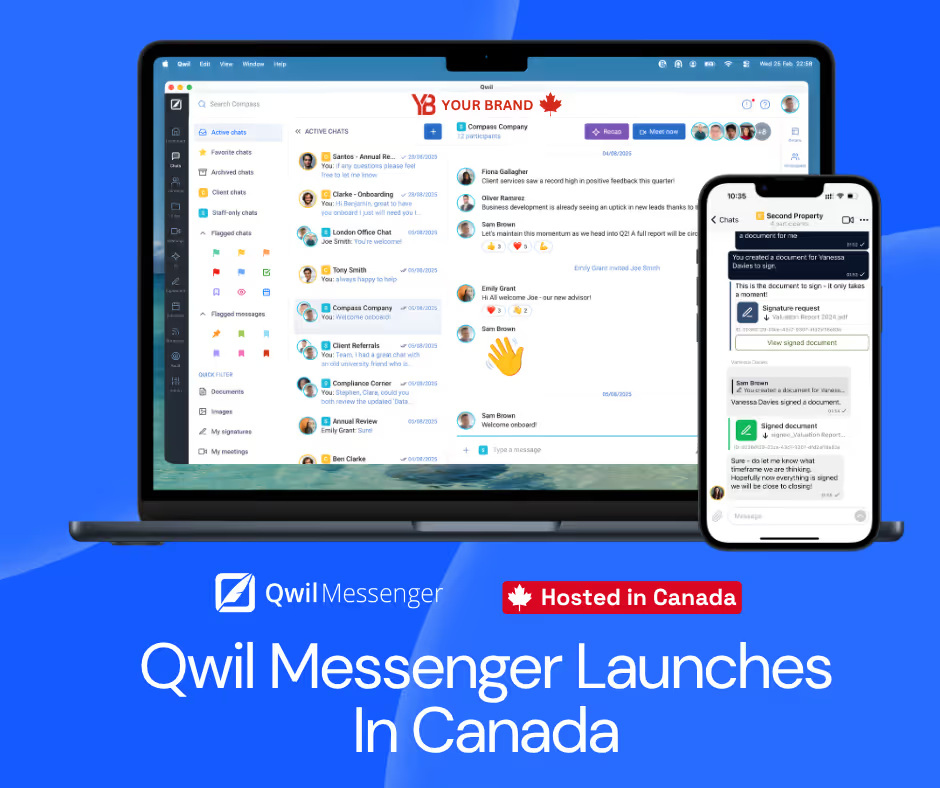
In Qwil, the entire workflow lives in one place: the conversation, the document, the signature request, the completed signature, and the storage of the signed record - all in the same encrypted, audited thread. Your audit trail tells a complete story.
Branded Client-Facing Experience
Your clients should interact with your firm's brand, not a third-party platform's brand. A white-labelled client portal - your logo, your colours, your name on every touchpoint - is not a luxury feature. It is a trust signal. Clients who receive a Qwil invitation and see your firm's branding understand they are entering your professional environment, not a generic tool.
Qwil provides full white-labelling on all plans. The client portal, mobile app, and all client-facing communications display your firm's identity.
Client Onboarding Steps
Client onboarding should be frictionless. In Qwil, the process takes about 30 seconds from the client's perspective: they receive an invitation via email or SMS, verify their identity, and gain access to your firm's secure environment via biometric login on mobile or browser on desktop. No password to create, no app store account required, no complex setup.
Compliance, Audit Trails, and Archiving
Compliance Standards Relevant to Canadian Businesses
Depending on your industry and client base, the following standards and regulations may apply to your communication platform:
PIPEDA - applies to all Canadian private-sector organisations engaged in commercial activity. Requires safeguards appropriate to the sensitivity of personal information, meaningful consent, and breach notification.
PIPEDA provincial equivalents - PIPA (BC and Alberta), Law 25 (Quebec) for provincial commercial activity. Law 25 imposes stricter consent and portability requirements.
CIRO / IIROC / MFDA - for financial services firms, supervision and recordkeeping requirements for client communications.
PHIPA and provincial health information acts - for healthcare providers, specific requirements for health information protection.
GDPR - if your business has clients in the European Union, GDPR applies to the processing of their personal data regardless of where your business is based.
HIPAA - if your business handles US patient data, HIPAA applies to those interactions.
ISO 27001 - not a legal requirement, but the leading international standard for information security management systems. Independent certification provides evidence of security programme maturity relevant to all the above frameworks.
Tamper-Evident Audit Trails
A tamper-evident audit trail records every access event, message, document transfer, and administrative action in a log that cannot be altered after the fact. This is distinct from a standard activity log, which may be modifiable by administrators. Tamper-evidence means that any alteration of the record - even by the platform vendor - is detectable or impossible.
In Qwil, all audit trail records are immutable. Once a message is sent or a document is accessed, the log entry is permanent. This satisfies the tamper-evident record requirements of PIPEDA's safeguards principle and supports legal and regulatory discovery obligations.
Retention Mapped to Regulatory Obligations
Map your retention schedule explicitly to the regulatory requirement that drives it. For each document and communication type: identify the applicable regulation, the minimum retention period, and the retention period you have configured in your platform. Review this mapping annually and update it when regulations change.
Configure quarterly compliance audits - a review of audit log samples, access control settings, retention configuration, and vendor compliance documentation. Document the outcome of each audit and any remediation actions taken.
Integrations, SDK, and Branded Experience
APIs and SDK Capabilities to Evaluate
A secure messaging platform that cannot connect to the systems your business already uses creates operational silos that undermine both efficiency and compliance. During vendor evaluation, ask for:
Documentation of available APIs - what data can be pushed and pulled, in what formats, with what authentication methods. A sandbox environment for testing integrations before deployment. SDK documentation for embedding the secure communication layer into your existing client-facing applications, if relevant. Examples of live integrations with CRM platforms comparable to what you use.
Qwil provides an open API and SDK that supports integration with Wealthbox, Salesforce, intelliflo, Plannr, and custom implementations. CRM integrations log all Qwil conversations against client records automatically, keeping your system of record complete without manual data entry.
SSO and User Provisioning
Single Sign-On (SSO) integration reduces authentication friction for staff while maintaining security. When an employee's identity provider account is deactivated - because they have left the organisation - their Qwil access is revoked automatically through the SSO connection, without requiring a separate administrative action. SCIM (System for Cross-domain Identity Management) support allows user provisioning and deprovisioning to be automated at scale for larger organisations.
Branded Client Experience Demos
Before committing to a platform, ask the vendor to walk through the client onboarding experience end-to-end - from the invitation email the client receives, through identity verification, to their first session in the platform. The client experience is the adoption test. If the onboarding is confusing, clients will not complete it. If the platform feels unfamiliar or unbranded, clients will question whether it is legitimate.
Implementation Checklist for Canadian Businesses
Work through these steps in sequence before going live with a secure messaging platform:
Data residency. Confirm in writing from the vendor that all data for your account is stored within Canadian infrastructure. Document the confirmation and file it with your privacy compliance records. Review annually.
Encryption scope. Confirm whether the platform uses true E2EE or TLS. Ask specifically whether the vendor can access message content at the server. Document the answer.
Secure email routing and archiving. If email remains part of your communication stack, confirm that outbound emails are archived in a retrievable, tamper-resistant format. Configure archiving before go-live, not after.
Access controls. Configure role-based permissions in the admin console before inviting any clients. Assign roles based on the minimum-necessary principle. Test that each role can access only what it should.
Audit trails and eDiscovery. Test the audit trail export function before go-live. Confirm you can produce a PDF transcript for a specific conversation within a specified date range in under ten minutes. Document the test outcome.
Client onboarding. Run the client onboarding flow yourself before sending invitations. Confirm the branded experience, the identity verification step, and the first session experience are all working correctly.
Staff training. Deliver role-specific training before the platform goes live. Cover what communication is permitted on which channels, how to handle a client who requests an alternative channel, what constitutes a reportable breach, and how to raise a security concern.
Migration and User Adoption Tips
Phased Migration Milestones
Migrating from a fragmented communication stack - personal SMS, email, WhatsApp, a separate document portal - to a single secure platform is an operational change that requires careful sequencing.
Phase 1 (week 1): Internal onboarding. All staff accounts configured, roles assigned, training delivered, and a pilot group of 5-10 clients invited.
Phase 2 (week 2): Full client rollout. Invite all active clients in waves. Send personalised invitations from the primary relationship holder. Set a target activation date and follow up with non-activating clients personally.
Phase 4 (week 3 onwards): Legacy channel retirement. Formally retire WhatsApp, personal SMS, and unencrypted email for sensitive client communication. Update your written privacy policy to reflect the new channels. Communicate the change to clients with a clear explanation of why the new platform is better for them.
Client Communication Templates for Transition
Prepare a personalised invitation message that explains what Qwil is, why your firm has chosen it, and what the client needs to do. Keep it short - three sentences maximum. Reference the security and privacy benefit directly: "We've moved to a secure platform that keeps your financial information protected and makes it easier to communicate with us."
For clients who are slow to activate, a personal follow-up from their primary advisor - not an automated reminder - is more effective than any automated nudge.
Success Metrics for Adoption
Track these metrics during and after rollout: client activation rate (target 80% of active clients within 60 days), message volume through Qwil vs. legacy channels, average client response time compared to email, and number of compliance-related support queries handled through the platform. Report these metrics to firm leadership monthly during the first quarter.
Vendor Comparison Criteria
When comparing secure messaging vendors for a Canadian business, score each vendor against these criteria:
Hosting location and digital sovereignty. Does the vendor provide Canadian data hosting for Canadian accounts? Can they confirm this in writing with specific infrastructure details? Do they use US-based subprocessors?
Security features and certifications. ISO 27001 (current certificate required). . True E2EE confirmed. Penetration testing on a documented schedule. Cyber Essentials Plus or equivalent.
PIPEDA compliance posture. Does the vendor provide a written contractual privacy schedule? Do they have a documented breach notification obligation to their clients? Can they produce their data processing documentation on request?
Integrations and SDK maturity. Native integrations with your CRM. Open API with documentation. SDK available for custom embedding. SSO and SCIM support.
Support SLAs and professional services. What is the guaranteed response time for security incidents? Is dedicated onboarding support included? What professional services are available for enterprise deployments? Is the support team Canadian?
Pricing and total cost of ownership. Per-seat or per-conversation pricing? What is included in the base price versus add-ons? What tools does the platform replace, and what is the net saving after tool consolidation?
Incident Response and Breach Playbook
Incident Notification Steps for Clients
When a security incident affecting client personal information occurs, your client notification must be prompt, clear, and actionable. The notification should explain what happened in plain language, what personal information was involved, what your firm has done to contain the breach, what clients should do to protect themselves (change passwords on affected accounts, monitor for unusual activity), and who to contact with questions.
Under PIPEDA, client notification is required where there is a real risk of significant harm. Send the notification as soon as feasible after that determination is made - aim for within 72 hours of confirming the breach. Notify the Office of the Privacy Commissioner simultaneously.
Evidence Preservation Procedures
The moment a suspected breach is detected, preserve all relevant evidence before taking containment action. In Qwil, this means: export the audit trail for the affected period before revoking any access. Preserve access logs, admin action logs, and any error or anomaly logs from the relevant timeframe. Do not alter or delete any records.
Assign a designated incident lead who is responsible for maintaining the evidence chain and producing documentation for the OPC if required. Document every action taken during the response, with timestamps and the name of the person who took the action.
Measuring ROI and Business Value
Productivity Metrics to Track
The business case for a consolidated secure messaging platform is not just compliance - it is operational efficiency. Track these productivity metrics before and after deployment:
Average client response time (target: reduction from 90+ minutes via email to under 10 minutes via secure chat). Time spent per advisor on communication-related administrative tasks (switching between apps, chasing signatures, managing calendar logistics). Volume of inbound phone calls to reception for queries that could be handled asynchronously (target: 30-40% reduction within 60 days of full rollout). Appointment no-show rate (target: reduction through automated reminders sent through the secure platform).
Quantifying Cost Savings from Tool Consolidation
Map your current communication tool stack and the annual cost of each component. A typical client-facing professional services firm is paying for: a secure email gateway or encrypted email service, a separate e-signature subscription (DocuSign or Adobe Sign), a video conferencing subscription (Zoom Business or Teams premium), an appointment scheduling tool (Calendly or equivalent), and a client portal or document management system.
Qwil replaces all of these. At $15 per staff member per month, the platform typically saves firms an average of $200 per staff member per month from tool consolidation - before counting the compliance overhead reduction and the time saved from app-switching. Based on Harvard research, employees switching between apps approximately 1,200 times per day lose roughly four hours per week - 10% of the working year - to context switching. A single consolidated platform recovers a meaningful proportion of that time.
For a firm of 10 advisors, the annual saving from tool consolidation alone typically exceeds $20,000. The compliance risk reduction - avoiding a PIPEDA breach investigation, a regulatory fine, or a client complaint that becomes an OPC investigation - adds a further risk-adjusted value that is harder to quantify but considerably larger.
Why Qwil Messenger is the Right Choice for Canadian Businesses
Qwil Messenger is the only platform on the market built specifically for regulated, client-facing professional communication with Canadian data hosting, true E2EE, immutable audit trails, and a client experience that people actually adopt.
PIPEDA compliance is not just about legality - it's about building client confidence in a digital-first era. The firms that will win client trust in the next decade are not those with the most tools. They are those with the most coherent, most secure, and most professional communication experience - one that clients can trust from the first message to the last document.
Qwil provides that experience. Canadian hosting. ISO 27001 certified. True E2EE. Immutable audit trails. Full white-labelling. CRM integrations. Built-in e-signatures and video.


Similar posts
.png)
Start your 30-day free trial


.svg)