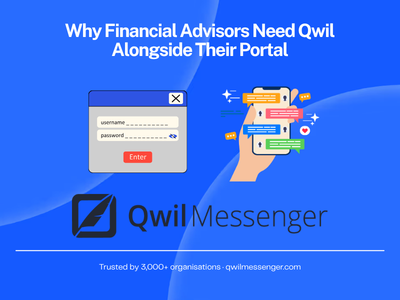
Your back-office system is not the problem. Intelliflo, Plannr, Wealthbox and their counterparts do a strong job of organising your firm's operations: cash-flow modelling, fee matching, compliance records, client data. For most adviser firms, a solid back-office system is non-negotiable.
But here is the gap. Your back-office system was built to serve your firm. Your clients were an afterthought. And when clients are an afterthought in the design, they behave like one in practice: they disengage, they go elsewhere to communicate, and your team ends up managing a sprawl of email threads, WhatsApp messages, phone calls and missed documents across half a dozen different channels.
Qwil sits alongside your portal to close that gap. It is the communication layer your back-office system was never designed to be.
The Short Version
Adviser platforms are built for advisers. That is the core of the issue. A client is expected to log into a platform a few times a year, navigate a layout that reflects how an adviser organises information, upload or download financial documents, and remember a password they set eighteen months ago. Between visits they forget their login, lose device access, or simply move on. The portal sits there, compliant and well-organised, waiting for a client who has no particular reason to return.
This is not a client failing. It is a design mismatch. Outside of their financial platform, the same client is messaging family, chasing tradespeople, and dealing with their bank, all through instant messaging. It is quick, familiar and conversational. It fits around their day rather than demanding they sit down and navigate somewhere new.
Portal adoption among financial advisers is growing, but client engagement within those portals tells a different story. Research consistently shows that clients who log in regularly are far more satisfied, more loyal, and more likely to make referrals than those who do not.
According to eMoney Advisor research, 66% of wealth management clients are given portal access. Of those 66%, half never log in again, and of the remaining 33%, only half log in once or more per month. That leaves you with an average of 16.6% average adoption rates for regular client usage.
Portals that require a client to remember a new login, navigate an unfamiliar interface and actively seek out information are fighting against every communication habit a client has built over the past decade.
When clients do not use the portal, they do not disappear. They find other ways to reach you. They email. They text. They call. They send documents as WhatsApp attachments. Some do all four for the same request.
The result for your team is a client communication operation spread across multiple channels with no central record, no consistent response process, and significant time spent chasing, sorting and reconciling. According to Qwil's own data, advisers using Qwil save an average of 62 minutes per day by consolidating client communication into a single channel. That is time currently spent switching between inboxes, re-reading email threads for context, and chasing document requests that were sent somewhere other than your back-office system.
Client retention is not just about having a portal. It is about how often your clients hear from you. According to a YCharts survey of financial advisory clients, 71% of those who receive frequent communication from their adviser feel very comfortable with their financial plan in the event of a recession. Among clients who are contacted infrequently, that figure drops to just 22%. That is not a marginal difference. It is the difference between a client who trusts your guidance when it matters most and one who quietly starts looking elsewhere.
The same research found that 88% of clients said increased communication frequency would sway their decision to stay with their adviser, and 89% said it would affect their likelihood of recommending their adviser to family and friends. Consistent, easy communication also drives long-term loyalty. The clients who stay are the ones who feel genuinely looked after, not just well-administered. And that requires a communication channel that makes staying in touch as effortless for the adviser as it is for the client.
WhatsApp now has over 3.3 billion monthly active users globally. More than 150 billion messages are sent on the platform every day. Over 80% of users check it daily. The average user spends approximately 38 minutes per day on WhatsApp alone. Globally 94% of people with internet access use instant messaging.
Another common talking point is that “my clients are older, they aren’t used to technology”. However clients aged 50 and above are among WhatsApp's most engaged demographics, using it for family group chats and community communication. The idea that older clients are not messaging people is no longer accurate.
The answer is simple: WhatsApp was not built for regulated industries. There is no verification of who you are talking to, meaning anyone can impersonate a client or colleague. Conversations are not logged to an audit trail, so there is no compliant record of what was said or shared. Data is hosted by Meta, with no control over jurisdiction or ownership, and if a staff member leaves, that conversation history goes with them.
WhatsApp is also not encrypted at rest and is not GDPR compliant for professional use. For a financial adviser operating under FCA rules, using WhatsApp to discuss client finances is not a shortcut. It is a liability, and not something you can actually use.
Your clients are sending and receiving dozens of messages every day before they have finished their morning coffee. Asking them to log into a separate, infrequently-used portal to communicate with their adviser is the hardest path to engagement available.
The solution: A platform that gives clients the familiar, instant messaging experience they already use every day, but built from the ground up with the security, compliance and data ownership that regulated firms actually need.
Chat is not just convenient. It is the communication model that fits how people actually think about quick exchanges of information. It is asynchronous: a client can ask a question in the morning and read the response at lunchtime without either party needing to be available at the same time. It keeps a natural record of the conversation. It removes the formality that stops clients from asking small but important questions.
When client communication feels as easy as messaging a friend, clients communicate more often. And more communication means a stronger relationship, faster response to document requests, fewer missed signatures, and less chasing for your team.
How Qwil Fits Alongside Your Portal
Your portal holds the records. Qwil handles the conversation that creates them.
Everything you do multiple times a day with clients, sharing updates, requesting documents, sending secure files, getting signatures, scheduling meetings and hosting video calls, happens in Qwil. It sits on your client's phone and on your desktop. It feels like WhatsApp. It works like a secure, compliant professional platform.
And everything that happens in Qwil is automatically logged and synced back to your back-office system, so your records are complete without anyone on your team having to copy, paste, forward or manually update anything.
Qwil removes the login friction that kills portal engagement. Once a client is set up, they access Qwil with Face ID or a passcode on their phone. No passwords to remember. No separate portal to navigate. A notification arrives, they tap, they are in.
Onboarding a new client takes 30 seconds. You invite them directly from within Qwil, they accept, and from that first interaction onwards every piece of communication, every document, every signature and every video call lives in one organised, searchable thread.
Qwil is not just secure for your firm. It is secure for your clients too.
Sharing a confidential document in Qwil is as simple as attaching a file in a chat. The client receives it in their secure Qwil environment, protected by banking-grade encryption to ISO 27001 standards. They can respond to document requests, submit their own files, and sign forms, all within the same platform and all protected by the same regulatory standards.
When a client sends a file to their adviser over WhatsApp or email, neither party has meaningful control over where that data goes or who has access to it. In Qwil, both sides of the conversation are protected, and your firm retains full data ownership throughout.
A client will not email you if sending a secure chat message is just as easy. They will not WhatsApp sensitive documents if they have a platform specifically designed for it. When clients have a good, easy, familiar channel to reach you through, they use it. And when they use one channel, your team only has one place to look.
Qwil removes the need to manage client communication across email, SMS, WhatsApp, phone and your portal simultaneously. Your inbox becomes quieter. Your team spends less time context-switching. Your compliance record keeps itself.
Firms using Qwil alongside their existing back-office systems consistently report:
Qwil integrates directly with the most widely used back-office systems and CRMs for financial advisers. All client conversations, documents and signatures are automatically synced, so your records stay complete without any manual effort from your team.
For platform-specific integration guides:
We are always building new integrations with the most popular platforms in financial services. See our full integrations page for the current list.
No. Qwil works alongside your existing back-office system or CRM, not instead of it. Your portal handles records, reporting and back-office processes. Qwil handles the client-facing communication that your portal was not designed for, and syncs everything back automatically.
Not necessarily. Many firms use both: the portal for client reporting and account views, and Qwil for day-to-day communication, document sharing, signatures and meetings. Qwil can also surface a link to your portal directly within the client dashboard, so clients move seamlessly between the two.
Qwil is available on iOS, Android and desktop. Clients can access it from their phone via the app, or on any browser via desktop. Onboarding takes 30 seconds and is handled entirely from within Qwil.
Qwil is built for regulated financial services. Every conversation is encrypted to ISO 27001 standards, every message and document is stored in an uneditable audit trail, and all data is hosted in your chosen jurisdiction to meet your regulatory requirements. Your firm retains full data ownership.
All records remain with your firm. Qwil's Data Reviewer gives compliance-authorised users access to the full communication history, searchable by sender, date, keyword and document, regardless of staff changes.
Signature requests are sent directly within a Qwil chat thread. Your client receives the request, reviews the document and signs within the same platform. Completed signatures are stored in the audit trail and synced to your back-office system automatically.


Protect client data with messaging they'll actually use.
Chat, share and sign in one place
Secure & compliant by design
Replace email and WhatsApp


.png)
.png)
.png)

.svg)