


Key takeaways:
- Email is an outdated communication system, lacking authentication and encryption
- Email workarounds like encrypted email are difficult for users to access
- Spamming and phishing concerns with emails
- Instant messaging has taken over the majority of our communication preferences
- Which secure communication platforms are best for financial advisors
TLDR
The last few years have seen this continuing trend of modern businesses, especially those in regulated industries, moving away from pure email communications. Financial advisors are no exception due to the secure nature of their client communications.
So why are they leaving emails behind? In short, compliance, convenience and security. From a technology standpoint, email is the digital representation of sending a physical letter. In a time where intercepting, or forging identity over an email is almost as simple as doing the same in a written letter, businesses must move forward. And they have been…
Why is Standard Email a Security Risk for Financial Advisors?
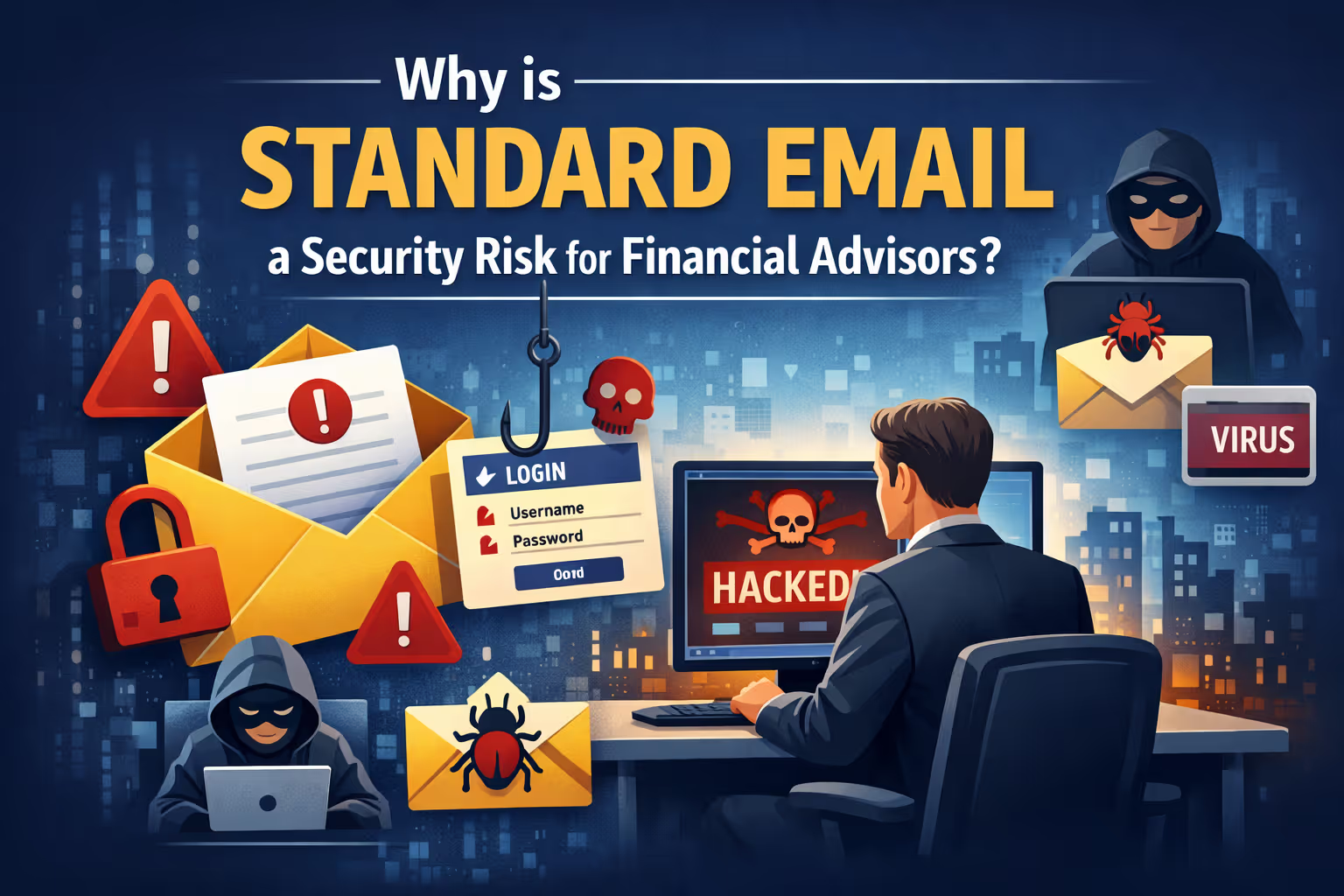
Cybersecurity is a critical reason why Email is no longer fit for purpose for financial advisors. As reported in the 2025 Verizon data breach report, 63% of businesses cited email as the primary vector for fraud attempts. The report also discovered that even after training, the median click rate of malicious links received by email was still 1.5% by staff.
So why is email so insecure? It comes down to a few things. The core of which is the fact that email does not enforce identity verification, or user authentication. It is extremely simple to go ahead and create an email address in someone else's name, and pretend to be them.
There is also the lack of encryption to consider. Email is a "hop-by-hop" system. Your message is only as secure as the weakest server it passes through. If the client’s provider (like an old Yahoo or AOL account) is weak, the "digital letter" is essentially sitting in an open mailbox.
Phishing and spam attacks are also on the rise. On an individual level, it is something we all notice, our inboxes are full of spam and phishing attacks. Reports from the Palo Alto Incident Report suggest since the advances in AI, Phishing attacks have seen a 1265% increase, with a 400% rise in success rates.
The "Encrypted Email" Trap: Solving One Problem, Creating Three
Many firms try to bridge the security gap by using "Secure Mail" plugins or encrypted email portals. While this might satisfy a basic compliance checklist, it often fundamentally breaks the client relationship. In 2026, clients expect "security by default," not "security by extra effort."
The Login Wall
Data shows that 92% of users will abandon a digital task if they are forced to reset a password. When a client sees a "Click here to log in to our secure portal" link, they don't see protection; they see a hurdle.
We spoke to advisors from St James’ Place who have felt this friction firsthand:
“More than 50% of the time we would receive a response saying that they were unable to open the encrypted email.”
The "Forgotten" Breach
Encrypted email is almost always "opt-in" for the advisor. One moment of fatigue—clicking "Send" without checking the "Encrypt" box—is all it takes for a Statement of Advice (SOA) to become a major GDPR or SEC breach.
One practice owner described the mental load this creates:
“I was getting tired of having to remember to encrypt some emails rather than others... Clients were getting sick and tired of having to login to the secure email system.”
Asymmetric Security (The One-Way Mirror)
You might send a secure email, but the moment your client hits "Reply" with their sensitive tax file or bank statement attached, that data is often sent back via their unsecured carrier. You’ve secured the outgoing door, but left the incoming one wide open, leaving your firm liable for a leak you didn't technically "cause" but certainly inherited.
Why Clients Prefer Instant Messaging For Financial Advice

When was the last time you sent an email to your friends over an instant message? The truth is, instant messaging is simply the superior form of communication. Taking the same comparison as we did previously, the instant message is the same leap from email, as email was from the letter. Let's compare the difference in engagement between the two:
Click here for a more in depth comparison of instant messaging vs email.
Appendix: The Advisor’s Glossary of Compliance
In 2026, regulatory oversight has moved from "periodic checks" to "continuous monitoring." If your firm is still relying on standard email, these are the specific rules and risks you are navigating:
SEC Rule 17a-4 (Electronic Record-keeping)
This is the "gold standard" for financial data retention. It requires that all electronic business records be preserved in a non-rewriteable and non-erasable format (often called WORM format).
- The 2026 Reality: The SEC now requires an audit-trail alternative. You must be able to prove exactly who accessed, modified, or deleted a record and when. Standard email archives rarely meet this level of forensic proof.
FINRA Rule 3110 (Supervision)
This rule mandates that firms have a "reasonably designed" supervisory system to monitor all business-related conduct.
- The Challenge: If your advisors are communicating via personal email or unmonitored SMS, you are in direct violation of Rule 3110. You cannot supervise what you cannot see. Qwil solves this by bringing all "off-channel" chat into a single, supervised ecosystem. Making it a leading choice as a FINRA Compliant Messaging App
The "Off-Channel Communication Sweep"
Since late 2021, the SEC and CFTC have issued over $2.5 Billion in fines for "off-channel" messaging. The sweep has now moved beyond Wall Street giants to mid-sized RIAs and independent firms.
- The Individual Risk: In 2026, FINRA is actively suspending individual advisors for security lapses. Proving you only use approved, secure apps like Qwil is now a matter of personal career survival.
E-Discovery (Electronic Discovery)
In the event of a lawsuit or audit, E-Discovery is the process of identifying and producing electronic information.
- The Friction Point: Performing E-Discovery on a fragmented email system is a manual nightmare that costs firms thousands in legal fees. Qwil centralizes all messages, files, and signatures in a structured, searchable database, allowing you to produce a "Compliance Pack" in minutes.
The Solution For Financial Advisors: Qwil Messenger
Qwil Messenger is the all in one solution for financial advisor client communication. From instant messaging, to secure file sharing, to e-signatures and more, all in one place. Built with banking grade security to cover your compliance on autopilot.
Qwil allows financial advisors for secure messaging for financial advisors, without sacrificing the client or staff experience.
- Onboard clients in seconds
- Control communication lists to dictate who can chat to who
- Share unlimited numbers of files up to 50Mb
- Complete audit trails and organisation
- Full CRM integration with advisor platforms
The 'Death of Email' isn't a funeral for communication; it’s a graduation. By moving your clients into a secure ecosystem like Qwil, you aren't just ticking a compliance box—you are building a modern, friction-free practice that captures the 98% attention span that email is currently losing. Stop fighting with 'hop-by-hop' servers and start talking to your clients where they already are.


Similar posts
.png)
Start your 30-day free trial


.svg)