

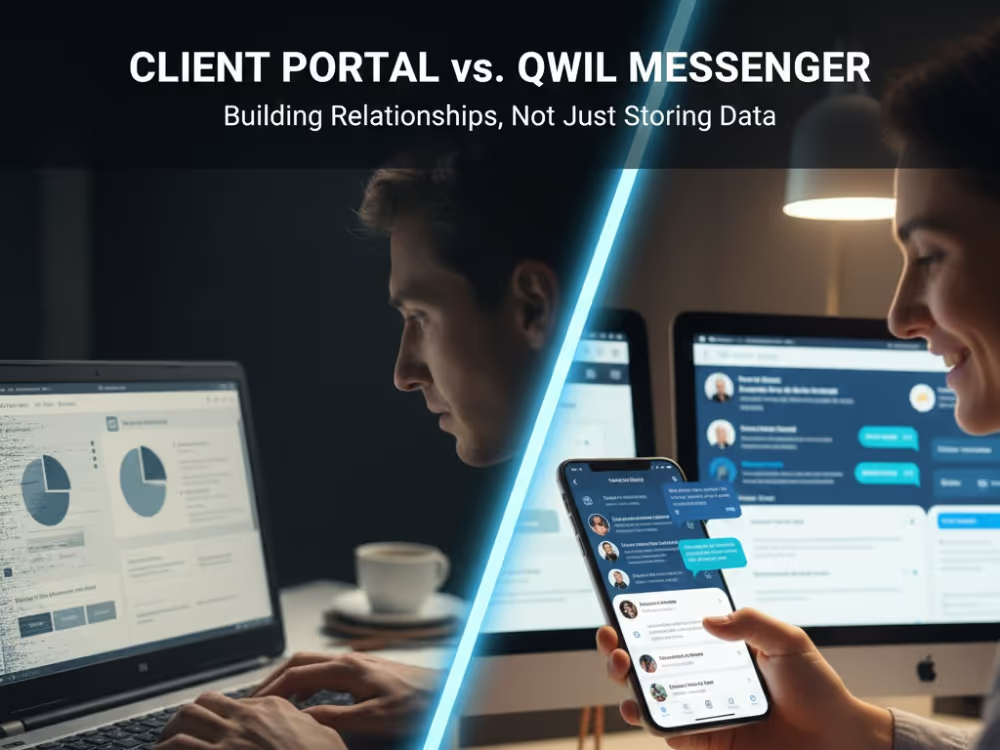
In the professional services sector, there is a growing divide between "storing information" and "building relationships." While client portals have become the industry standard for the former, they are increasingly proving to be the graveyard of the latter.
For prospects, clients, and staff, the friction of a traditional portal—the "login wall"—is a barrier to the high-touch, responsive service that modern business demands. To truly build a relationship-managed business, firms must move away from irregular portal visits and toward continuous, cross-platform communication tools like Qwil Messenger.
Most client portals are designed as administrative hubs. They are excellent for viewing a portfolio, downloading an annual tax statement and viewing correspondance. However, they are fundamentally flawed as communication channels for several reasons:
1. The "Login Wall" Friction
A portal requires a client to remember a password, navigate to a specific URL, and pass through a multi-step login process just to ask a simple question. In a world where clients are used to the immediacy of WhatsApp, a portal feels like "work."
2. Disjointed Interfaces
Portals often provide a different experience for staff than they do for clients. Staff might use a desktop-heavy CRM view, while the client sees a simplified web interface. This creates a "digital disconnect," where neither party is looking at the same conversation in the same way, leading to confusion and delayed replies.
3. "Out of Sight, Out of Mind"
Because portals aren't part of a client’s daily digital habits (unlike messaging apps), notifications are often buried in email spam. This leads to the "Irregular Visit" cycle: the client only logs in when they absolutely have to, preventing the proactive, daily rapport that builds long-term trust.
4. Not the main channel
Messaging functionality within a portal is often an afterthought - more akin to embedded email, or 1-1 help centre chat which is not what parties expect. The result is continuing to use Teams internally, email, encrypted email or WhatsApp (despite the risks) ie. outside of the secure portal - often on the client's demand. Qwil provides the full communication experience for all staff and all clients helping streamlining the tools rather than adding one on top of the existing ones.
Why Qwil is the Professional Standard for Relationship Building
Qwil Messenger is designed to solve the "Relationship Gap" by combining the ease of a WhatsApp type messaging (on desktop and mobile) with the security of a banking-grade platform - whilst facilitating a link to the portals by embedding the URLs.
Desktop & Mobile: The Power of Presence
Unlike a portal, which is a destination, Qwil is a presence.
- For Staff: The desktop app integrates into their daily workflow, allowing them to manage dozens of client relationships. The mobile app also enables them to be present on the go.
- For Clients: The mobile app sits on their home screen. When a staff member sends a message, it appears as a native notification. There is no password to remember every time—just a biometric (FaceID/Fingerprint) unlock and they are in. Clients also have access to the desktop when required - such as reading a longer documents.
From Prospect to Client: Seamless Onboarding
One of the greatest weaknesses of portals is that they are usually reserved for existing clients. Qwil allows firms to invite prospects into a secure "walled garden" from the very first meeting. This sets a professional tone immediately, moving the prospect away from insecure email or SMS and into a branded, secure environment where documents can be shared and signed before the first official contract is even finalized.
Relationship Management vs. Portfolio Management
Summary: Building a "Living" Relationship
If your goal is simply to host documents and formal correspondence, a portal is sufficient. But if your goal is to be a trusted adviser, you need to be where your client is.
By using a tool like Qwil, you complement your portal with a living, breathing conversation. You move from being a "utility" that the client visits occasionally to a "partner" who is only a tap away. In the professional industry, that accessibility is the difference between a transactional account and a lifelong client.


Similar posts
.png)
Start your 30-day free trial


.svg)